 revio
revio revio
revioDigital Membership Cards for Gyms: A Complete Guide
Gyms are losing retention to competitors bundling perks. How a digital membership card in Apple and Google Wallet turns a gym sign-up into a perk network.

Most gyms sell a membership once and then spend the next twelve months hoping the customer keeps showing up. The gym floor is the product, but the membership itself — the thing the customer pays for every month — only exists as a row in the front-desk software. Nothing to carry. Nothing that reminds a member, on a random Tuesday, that they belong somewhere.
A digital membership card does not fix retention on its own. Hand members a nicer-looking version of the same plastic card and you have changed nothing. What does seem to move the needle is when the card also unlocks something outside the gym: a discount at the apparel shop down the street, a deal on supplements, half-off coffee after the 6am class. The membership suddenly reaches past the treadmill, and the member has a small reason to remember you several times a week instead of once a month when the payment goes through.
That is the pattern I want to talk about here. fit90 is one of the better examples I have seen of it working in practice, and their story is a good way to think about whether it fits your own gym.
Why a membership card beats a loyalty card for gyms
Loyalty cards are built for small, repeated purchases. Stamp ten coffees, get a free one. Earn points per visit, redeem for a product. That pattern belongs to cafes, smoothie bars, and car washes — places where every visit is a discrete transaction.
Gyms are not like that. A member pays once a month or once a year and then shows up however often they feel like. There is no per-visit purchase to reward. I have watched gym owners try to graft a stamp-card model onto their program and quietly abandon it within a year. The mechanic just does not map.
A membership card is a different thing. It does not ask members to earn their way to anything. It is a credential — a wallet pass that proves "this person is a current member." Partner merchants scan it and apply a discount. That is the whole interaction.
The mental difference is worth noticing. Loyalty says earn something. Membership says you are already in. Gym members already think of themselves as members; the card reinforces what they already believe instead of asking them to adopt a new behavior.
The fit90 story
fit90 is a boutique fitness chain with a solid base of members. Their problem was not the product. Classes were good, trainers were good, retention was respectable. Their problem was that competitors had started bundling perks — apparel discounts, supplement credits, recovery partnerships — and every time a member saw a competitor's offer stack, fit90 looked a little plainer by comparison.
They could have built those partnerships themselves, one at a time, a custom flow per brand. That idea dies the moment you think seriously about it. Every apparel brand wants a different checkout path. Supplement companies want unique promo codes. Managing five of those at once is a full-time job, and fit90 did not want to hire someone to coordinate discount codes.
What they needed was a single credential every partner could verify in five seconds at the register. That is what we built with them.
How it works for the member
The member experience has to be nearly invisible. fit90 members are busy; enrollment needs to take about thirty seconds or adoption dies.
The flow is: scan a QR code at the front desk, tap "Add to Apple Wallet" or "Save to Google Wallet," done. No app. No login. No password they will forget next month. The pass lives next to their boarding passes and credit cards, somewhere they already look several times a week.
When they walk into a partner shop, they pull the pass up and hand the phone to the staff. That is it.
How it works for the partner
The partner side is usually what kills these programs. Small businesses will not adopt anything that requires POS changes or staff training. If the apparel shop two blocks from fit90 had to install new hardware to participate, they would have politely declined.
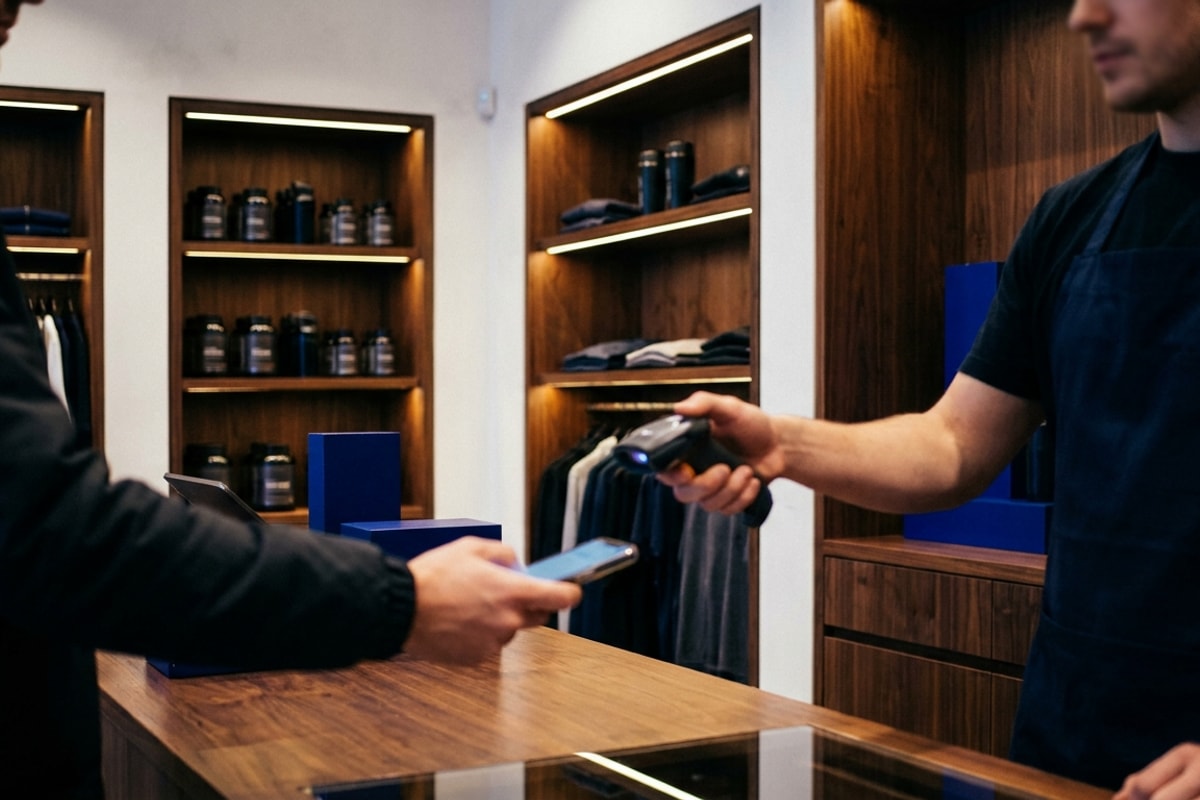
Instead, each partner bookmarks a scanner URL on a device they already own. When a fit90 member wants to redeem, staff opens the bookmark and scans the QR code. Green check, active member, apply the discount. Red X, lapsed, politely decline. The entire training is "open this link, press the camera icon."
What fit90 sees on their side
The admin dashboard took the longest to get right. Without data, partner conversations run on faith: we think this is working. With data, those conversations become concrete: here is how many members redeemed at your shop last month, here is how that grew from the quarter before.
fit90 can see which partners are producing traffic, which are coasting, which members are redeeming across multiple partners. When renewal time comes with an apparel brand, the conversation is "here is what you got, here is what we are proposing for the next year" — which is a conversation partners want to be in, because they get to see evidence.
Why the pattern suits gyms specifically
Three things make this work unusually well for gyms.
First, identity. Gym members self-identify as members in a way that a cafe customer does not think of themselves as "a member" of the cafe. The word is already in the transaction. Handing someone a wallet-native artifact that reinforces an identity they already hold is a lot easier than creating a new one from scratch.
Second, the partner list is almost obvious. For a cafe, the right partners are hard to figure out. For a gym, the categories are practically given: activewear, supplements, recovery and physio, smoothies and meal prep. You are matching to things your members are already spending on elsewhere.

Third, retention economics. Two percent off monthly churn is the difference between a profitable gym and a slowly dying one. Anything that makes members feel their membership has value outside the four walls of the building reinforces retention. The perk network becomes a psychological anchor — cancelling starts to feel like losing more than just the gym.
Mindbody's industry reports have shown for years that members who engage with ancillary offerings churn at lower rates than members who only use the equipment. A perk network is a lightweight version of that same effect, with far less operational overhead than adding new programs inside the gym.
If you are going to do this, get three things right
Start with three to five partners, not fifteen. The list being short is fine; what matters is that those partners are places your members would buy from anyway. A discount on something they already buy feels like value. A discount on something they have never heard of feels like spam.
Make the enrollment QR visible everywhere members touch the gym: front desk, locker rooms, post-workout check-in, the signature line of your staff's emails. Enrollment friction determines everything downstream. My earlier piece on running loyalty programs without an app covers the behavioral argument for why this matters.
Give each partner about fifteen minutes to set up the scanner. No hardware purchase, no POS changes. If you cannot get a partner onboarded in a single short call, the partner is not really interested.
FAQ
Does this replace our gym management software? No. The pass sits on top of whatever CRM or gym platform you already use. Billing, class scheduling, member records — all of it stays where it is. The pass is just a credential that members carry and partners verify.
What happens when a member cancels? The pass shows as expired the next time someone scans it. Partner merchants see a red X and decline the discount. You do not have to chase anyone down.
Multi-location gyms? One pass per member, valid at every partner regardless of which location the member originally joined at. The dashboard can filter by location if you want to see perk usage per gym.
How is this different from an app-based program? There is no app. The pass lives in Apple Wallet or Google Wallet, which are already on every iPhone and Android. That alone is most of the reason these programs outperform app-based loyalty. See what is a digital loyalty program for the longer version.
Cost? Depends on member count and partner count. For a boutique gym with fewer than 2,000 members and ten-ish partners, costs typically land in the low four figures per year plus a one-time setup fee. See our pricing breakdown.
None of this is magic. A membership card will not save a gym with a weak product. But if the product is solid and the base is loyal, this is one of the cheaper, lower-friction ways to make the membership feel bigger than the building — and to build a dashboard of real partner-delivered value that makes renewal conversations easier every year.
If you want to see what a fit90-style deployment would look like for your own gym, reach out and we can walk through the partner map.
Sara Al-Farsi
Head of Merchant Success, Revio