 revio
revio revio
revioShared Membership Cards for Local Merchant Networks
Merchant associations and BIAs are replacing stacked loyalty apps with one shared digital membership card in Apple and Google Wallet. How the pattern works.

Walk down any main street in a mid-sized city and count the loyalty programs on display. Every cafe has a punch card. The salon has a stamp card. The bookstore gives out a plastic keytag. The bakery has an app. The dry cleaner tracks it on an index card behind the counter.
From the customer's wallet, that is clutter. Three keytags, two apps, and a paper card that gets lost between laundry cycles. Each program makes sense on its own; the combined experience of being a regular in a neighborhood is a mess.
Merchant associations, downtown Business Improvement Districts, and retail co-ops are starting to replace that fragmented landscape with one shared credential — a single digital pass, issued to residents or members of the community, that every participating merchant recognizes at checkout. It is a quietly effective pattern, and I think most walkable neighborhoods could pull it off.

What a shared membership card actually is
A shared membership card is one wallet pass, issued by an organizing body (a BIA, a chamber, a residents' association), that:
- Identifies the holder as a member of the community or program
- Is recognized at every participating merchant as a valid discount credential
- Lives in Apple Wallet or Google Wallet, not in a dedicated app
The organizing body sets the terms — who qualifies as a member, what the discount structure looks like at each merchant, what the branding conveys. The key difference from traditional loyalty is that the card is issued centrally, not per-merchant. Every merchant honors the same credential. Members join the network once, and the full set of perks becomes available.
Why this pattern is winning over per-merchant loyalty
Three reasons, in roughly decreasing order of importance.
Customers actually carry it
A single card in the phone wallet is not just easier than three keytags. It is an order of magnitude easier, because it does not require the customer to remember which store uses which program. Research from Baymard Institute has shown for years that reducing steps in any transaction funnel produces outsized gains in completion, and the same logic applies here. Members who only have to remember one credential will use it. Members who have to remember seven will use none.
Once a pass lives in Apple Wallet or Google Wallet, the member sees it every time they open their wallet to pay. That passive visibility creates a small habit loop: I am in this neighborhood, let me see what stores honor my card. That is the behavior the organizing body wants.
Merchants share the customer acquisition cost
In per-merchant loyalty, the bookstore spends money acquiring bookstore members, the cafe spends money acquiring cafe members, and those customer sets rarely overlap in the merchants' data. In a shared network, the bookstore's customer is automatically exposed to the cafe, because the same card works at both.
Merchants in a shared network tend to see a meaningful share of redemptions from customers who are new to their specific store but already regulars of another store in the network. That is new foot traffic the merchant would not have acquired on their own. It is also the core pitch for recruiting merchants: your participation gives you access to every other participant's existing customer base.
The organizing body finally has data
BIAs, merchant associations, and chambers of commerce are historically weak on data. They rely on anecdotes ("merchants tell us foot traffic is up") and surveys with wide error bars. A shared card program gives the organizing body concrete, per-merchant redemption data, which makes every conversation — grant applications, sponsor pitches, merchant recruitment — more credible.
How the pattern gets implemented
Enrollment starts with a single branded link. The organizing body distributes it through whatever channel they already have: a BIA newsletter, QR posters in participating storefronts, social campaigns, printed materials inside stores. One tap adds the pass to the member's wallet. No app download, no account creation.
Partner scanner setup takes about fifteen minutes per store. Bookmark the scanner URL on a device the store already has, configure the discount tier, train staff in two minutes: when a customer pulls up their pass, open the scanner and press the camera button. No POS integration, no new hardware, no vendor-specific training.
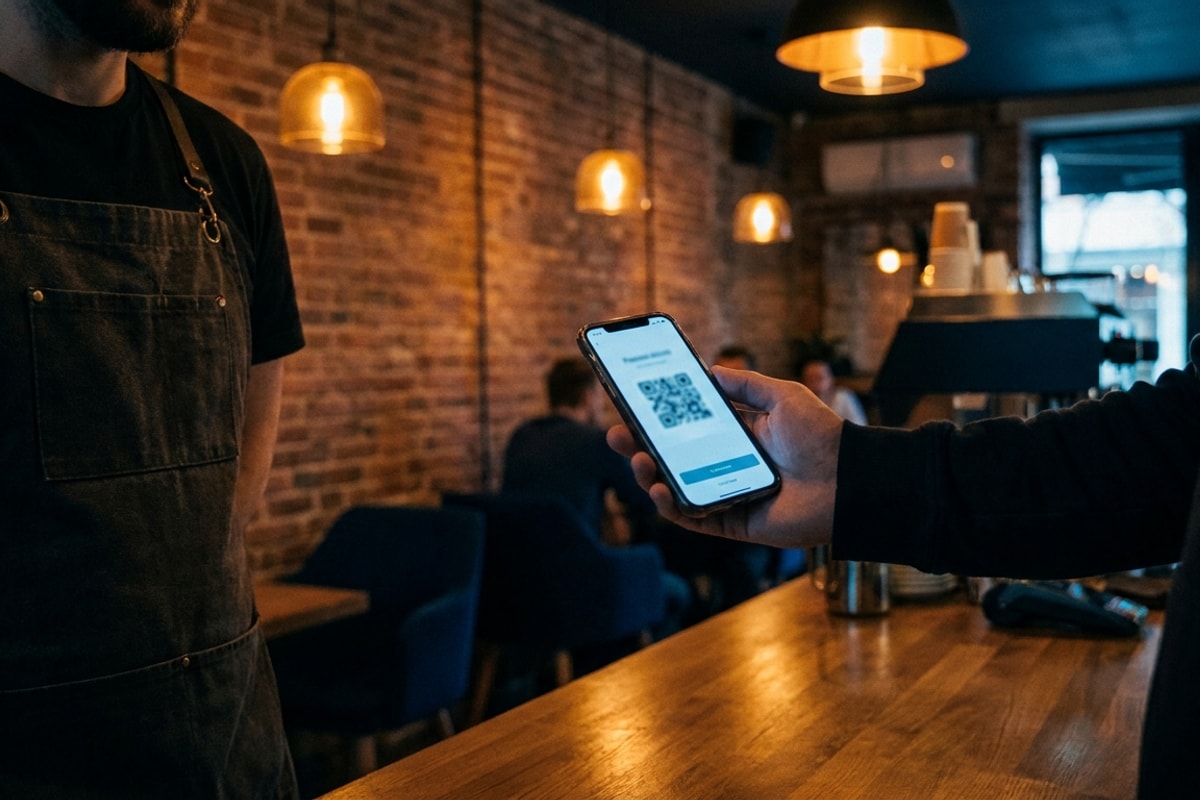
At checkout, the customer pulls up their pass, staff scans the QR code, the scanner confirms the pass is valid and shows the applicable discount, staff applies it. The whole exchange adds about five seconds to the transaction.
The dashboard is where the long-term value lives
A typical merchant-network dashboard shows:
- Redemption volume by merchant, by month
- Cross-merchant overlap — how many members use more than one participating store
- Enrollment growth over time
- New-customer share per merchant
The cross-merchant overlap metric is the one most organizing bodies under-use. It is the clearest quantitative argument for the pattern itself. If members of the network use five different participating stores, the program is producing genuine cross-traffic — which is exactly what a BIA or merchant association exists to produce.
Three ways this goes wrong
Too many discount tiers. Simplicity is the whole point. If every merchant runs a complex tiered discount, staff get confused, members lose track, and the scanner UX gets cluttered. A flat 10% or a simple two-tier system works better than a complex matrix.
A weak merchant roster at launch. A shared card with three participating merchants does not feel like a network. For a neighborhood-scale program, 15–25 participating merchants is a reasonable minimum before the card feels like a real perk.
No renewal mechanism. The pass should expire and re-issue on a clear cadence, usually annually. Without expiry, the card goes stale. Former members keep redeeming indefinitely, and the organizing body loses a natural touchpoint to re-engage.
FAQ
Who issues the card — the BIA or the individual merchants? The organizing body issues centrally. Merchants are participants in the program, not issuers. That is what makes it "shared" instead of stacked.
What kinds of discounts do merchants typically offer? A flat percentage (10%–15% is typical), a fixed dollar amount on a qualifying purchase, or a free add-on item. Most organizing bodies publish a reference guide so merchants can pick a structure that fits their margins.
How do merchants verify someone is actually a current member? The scanner handles it. When staff scan the pass, the system checks against the organizing body's member list. Active members get a green check; expired or unknown passes get a red X. No manual list-checking at the register.
Can we track which merchants are pulling their weight? Yes. The dashboard shows per-merchant redemption volume, so the organizing body can tell which merchants are getting real use and which are coasting. That becomes the basis for renewal conversations.
Does this work for a small town with only a handful of businesses? The pattern works at any scale, but the value proposition is strongest where there are at least a dozen potential participating merchants. Fewer than that and a spreadsheet or a printed coupon booklet is probably simpler. See how much does a digital loyalty program cost for scale considerations.
Shared membership cards are quietly replacing stacked per-merchant loyalty in neighborhoods that have a coordinating body capable of issuing the credential. The pattern works because it aligns members, merchants, and organizers around a single artifact — one that lives where modern consumers already look, which is their phone.
If you run a BIA, merchant association, or local business group and you are thinking about this, get in touch. We can walk through how to set up a shared card program tailored to your district's merchant mix.
Sara Al-Farsi
Head of Merchant Success, Revio